
Visual comparison
Left: OSD-JSCC (ours) Right: a baseline or the original AWGN channel, compression ratio 96. Drag the slider to compare.
| Method | PSNR (dB) ↑ | LPIPS ↓ | DISTS ↓ |
|---|
Drag to move the divider · Double-click, Ctrl/⌘ + scroll or pinch to zoom · Drag to pan when zoomed · ← → move the divider
Abstract
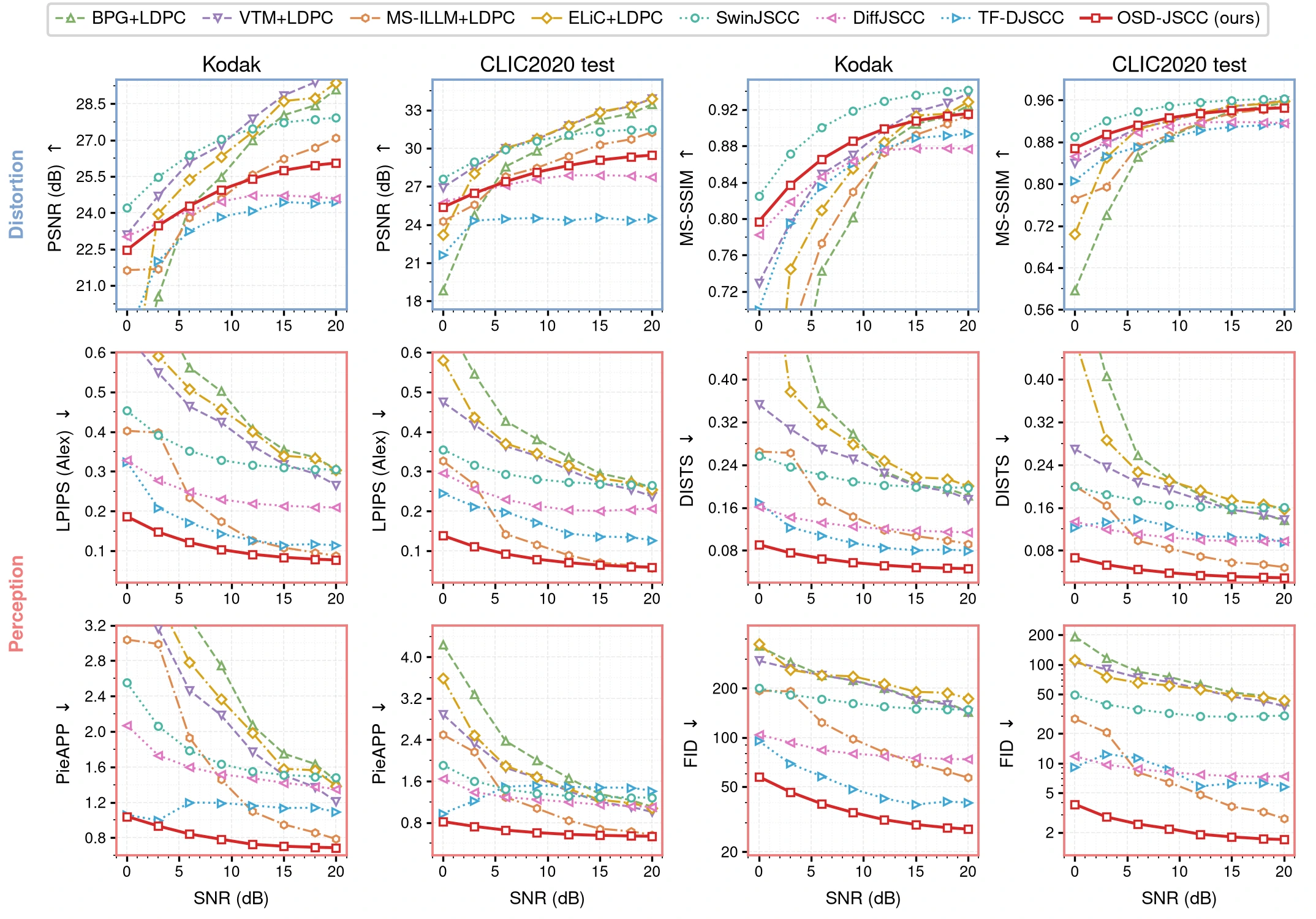
Neural joint source–channel coding (JSCC) enables efficient image transmission over noisy channels, yet distortion-optimized JSCC decoders tend to produce blurry reconstructions. Diffusion priors restore realistic detail but incur substantial decoding latency, and one-step diffusion models cannot be applied directly, since they expect Gaussian noise of a fixed level rather than SNR-dependent channel distortion. We propose OSD-JSCC, an SNR-adaptive JSCC framework that reconstructs images with a single diffusion step. OSD-JSCC transmits pretrained variational autoencoder (VAE) latents through an SNR-conditioned latent JSCC codec and introduces two key designs. First, a stochastic diffusion-state interface lets the JSCC decoder predict a Gaussian diffusion state rather than a clean latent, together with semantic and SNR tokens that guide the one-step refinement. Second, SNR-conditioned feature modulation and adaptive timestep selection jointly adapt latent transmission and diffusion refinement to the channel quality. A three-stage training strategy with low-rank adaptation (LoRA) efficiently adapts the pretrained prior. On Kodak and CLIC2020, OSD-JSCC achieves the best perceptual quality at almost every SNR; compared with DiffJSCC, it reduces LPIPS at 0 dB by 43% and 53%, respectively, and decodes 50.6× faster.
Method
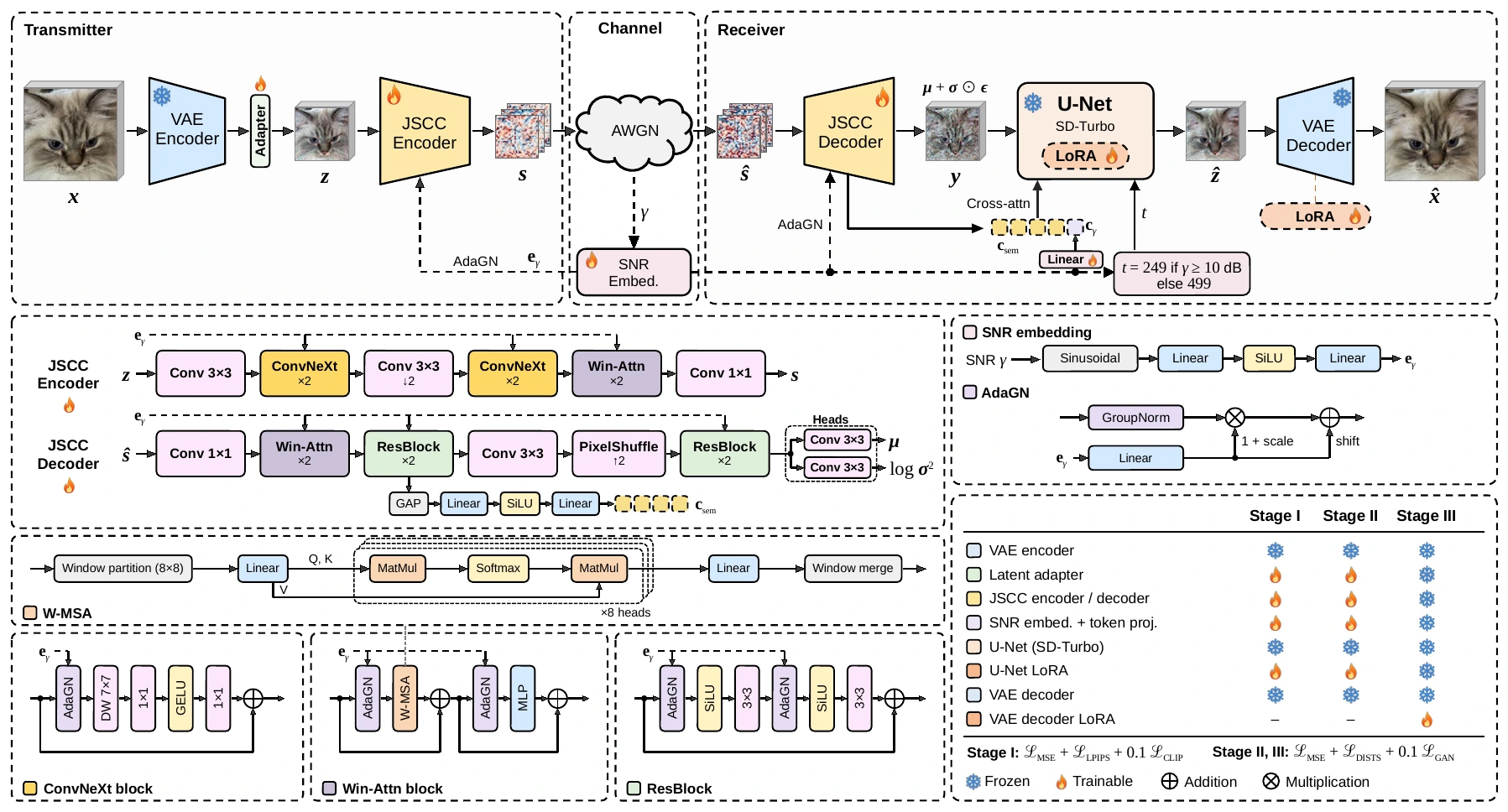
The transmitter encodes the image with the frozen SD-Turbo VAE, maps the latent to channel symbols with the SNR-conditioned JSCC encoder, and sends them over the channel. The receiver's JSCC decoder does not try to recover a clean latent. It predicts a Gaussian diffusion state y = μ + σ ⊙ ε together with semantic tokens. One U-Net step then refines the state, and the VAE decoder renders the image.
- SNR-adaptive transceiver. Every JSCC encoder and decoder block is conditioned on the channel SNR through adaptive group normalization (AdaGN).
- SNR-dependent timestep. The U-Net starts at t = 499 below 10 dB and at t = 249 from 10 dB upward, so noisier channels get more denoising.
- Lightweight adaptation. The VAE and U-Net stay frozen. Only LoRA adapters, the JSCC codec and the conditioning tokens are trained, in three stages.
Quantitative results
Runtime
| Method | Encoding (ms) | Decoding (ms) | Total (ms) |
|---|---|---|---|
| BPG + LDPC | 65.0 | 10.0 | 75.0 |
| VTM + LDPC | 8086.8 | 64.2 | 8151.0 |
| MS-ILLM + LDPC | 30.5 | 41.0 | 71.5 |
| ELiC + LDPC | 82.5 | 56.8 | 139.3 |
| SwinJSCC | 10.4 | 10.9 | 21.3 |
| DiffJSCC | 4.5 | 3399.4 | 3403.8 |
| TF-DJSCC | 134.2 | 382.9 | 517.2 |
| OSD-JSCC (ours) | 24.5 | 67.2 | 91.7 |
Mean time per Kodak image at 12 dB on one NVIDIA RTX PRO 6000.
BibTeX
@misc{tang2026osdjsccneuraljointsourcechannel,
  title={OSD-JSCC: Neural Joint Source-Channel Coding with One-Step Diffusion},
  author={Shunpu Tang and Qianqian Yang},
  year={2026},
  eprint={2611.06437},
  archivePrefix={arXiv},
  primaryClass={eess.SP},
  url={https://arxiv.org/abs/2611.06437}
}